
My semi-autobiographical novel Muslamic Ray Gun was written about seven years ago, and published in 2017, towards the end of perhaps my most productive period of writing. I’ve made no secret of the fact that there are some autobiographical elements within the book. The lead character went to public school but was expelled. He found a kinship with a hapless bunch of juvenile skinheads, and he was ideologically groomed by an older, political skinhead. That part has a basis in truth, but everything after that is pure fiction.
So what the hell is a Muslamic ray gun? It comes from a viral video of a drunken lout attending an English Defence League march being interviewed by a journalist, and giving an almost incomprehensible speech about Muslims invading the UK, with their Muslamic ray guns. What he actually meant to say – incoherently – is Islamic rape gangs. Or it might’ve been Muslamic rape gangs. But the video went viral, and the drunken, racist lout was ridiculed across the country. There’s even an autotuned version of his interview, with him singing, “I’m going on a march, ’cause I wan’ Britain to be about British,” and telling us, “Ya got interracial law, the Muslamic infidels, they’re tryin’ ta get their law over our country.” It’s hysterical.
And that title just seemed perfect for a novel I was planning to write about a former Combat 18 member who ends up in prison and, after a lengthy term inside, comes out to a world vastly changed from what it was when he was convicted. It’s the third in my trilogy of novels about the problems men face, and without a doubt it’s the most uncomfortable to read. Racist language is used throughout, both by the narrator and lead character Andy Huxtable, and by the racist characters he hangs around with. In prison, he learns the power of ideological grooming, but when he comes out, though the country has changed, his home town is full of immigrants, Andy is a changed man. He finds the members of the local English Defence League group to be an embarrassment. He is uncomfortable when his former best friend comes out with racist language, and his former wife, once a member of the BNP, is far too extreme for him to deal with. On the fringe of the EDL group as they seek out the members of an Islamic child rape gang, and after meeting his daughter for the first time, he realizes that this isn’t his world anymore.
Ultimately, Muslamic Ray Gun is about racism, ideological grooming and waking up to the reality that racial identity politics is really just a load of utter bullshit. It isn’t meant to be an easy read. Liberals and leftists won’t like it because it’s centred around a group of racists – not that any of them are painted in a particularly good light. Those on the right won’t like it, because it shows how absurd racism is, and that – usually – racists aren’t very intelligent. And those in the centre won’t like it because even though they’d never admit it, they may find a bit of themselves in amongst the casual racism flung around by the main cast. I wanted it to be uncomfortable, and to show that no matter what a person’s race is, deep down we are all just people, each of us with similar needs and desires, and most of the same emotions.
Do I preach politics in the novel? I don’t believe I do. I’m not a racist, but I’ve been on the fringe. I’ve even met Martin Cross, the infamous (although little known) Combat 18 murderer and bass guitarist who was sent to prison for life for basically stabbing a guy to death over some borrowed tools and some in-fighting within Combat 18 (but mainly the borrowed tools). I know a little of what went on in that world, though I hasten to add that my link to the life of a skinhead was over before I even left my teens. I don’t believe there is anything preachy in the book. You want to be a racist, whether a white supremacist or an anti-whiteist, that’s your choice. All I know is that I wanted to tell a story and nothing more. Muslamic Ray Gun is a tale set amongst the awful world of racism, utter stupidity, and, I hope, a redemption of sorts.
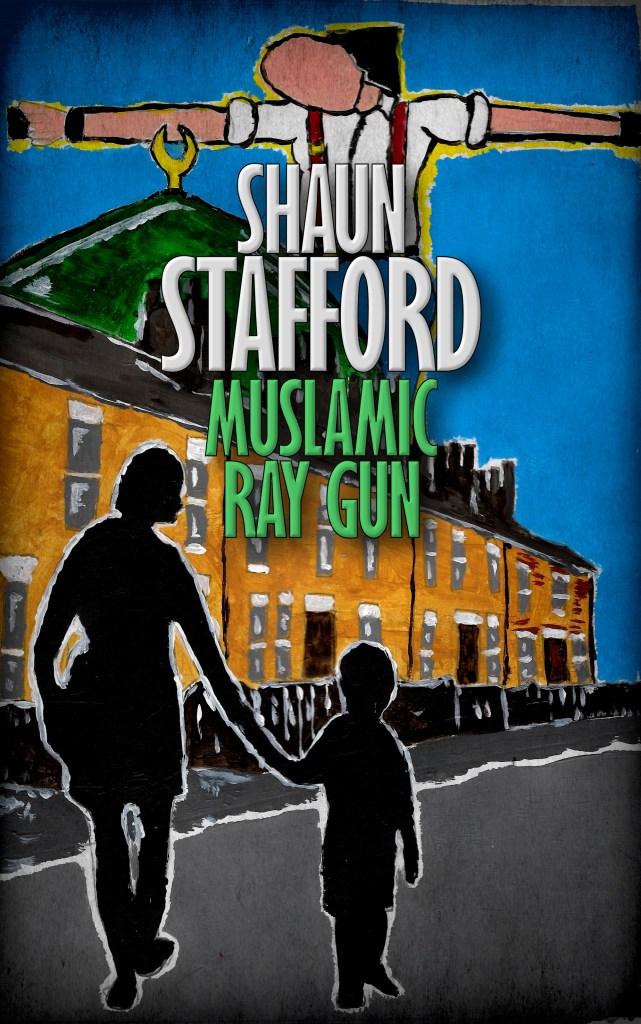
As an aside, one of my friends lends his name to one of the racist characters in the book, and he also rewarded me with his artwork for the cover, which shows a skinhead being crucified against a backdrop of the huge Faizan-E-Madina mosque in Peterborough, the nameless city where the novel was mostly set. Thank you, Olly.


 Shaun Stafford's Putrid Underbelly